
• Log In

Music Performance and Body Seminar

Towards a musician’s guide to understanding the performing body.

  • About
  • Stressed?
  • Brainstorm!
  • No pain no gain
  • Could you repeat please?
  • Out of breath?
  • Life changes…
  • Contact

La voce!

“[ D ] Kees van Dongen – Modjesko, an Opera Singer (1908)” by Cea.is licensed under CC BY 2.0

The vocal apparatus

1. Vibratory body (vocal folds)

What are the vocal folds?

  • The vocal folds are made of striated muscle fibres, squamous mucosal epithelium (flat cells resembling fishy scales) and collagen elastic fibers (Abitbol 1999, 428). 
  • Vocal folds are 5mm long in a child, and lengthen with time until puberty, when growth stops. Their full-growth length is approximately 17mm in women, and 23 mm in men (Abitbol 1999, 427).
  • The vocal folds are formed in a “V”, laying horizontally, and connecting at the back to the left and right arytenoid cartilages, which are what allow the folds to open and close.
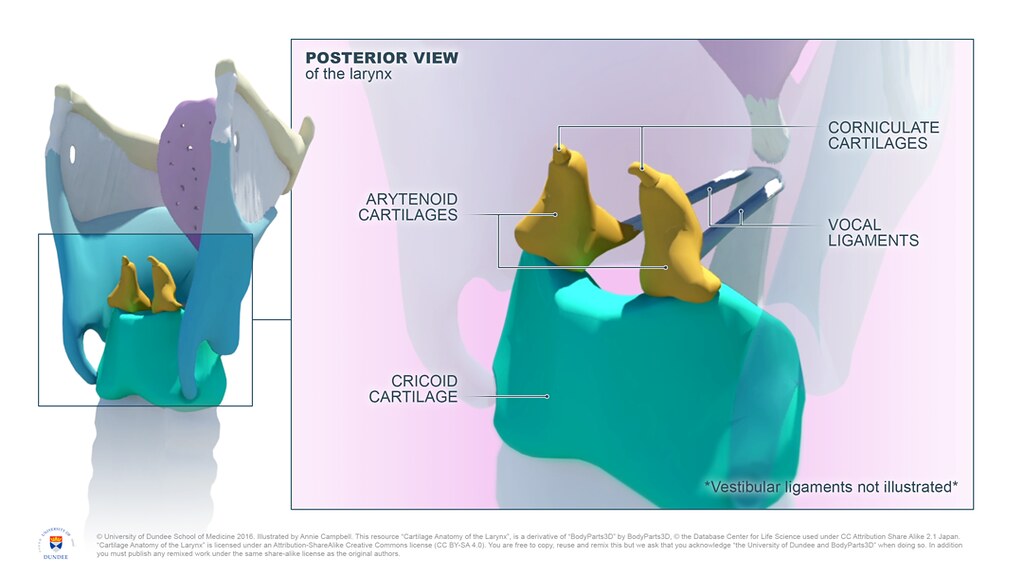
“Cartilage Anatomy of the Larynx by Annie Campbell” by dundeetiltis licensed under CC BY-SA 2.0

How do they create sound?

  • The brain sends out a neurological command telling the folds to vibrate.
  • Specifically, it is the vagus nerve (Xth cranial nerve) which makes the larynx open and close (Abitbol 1999, 430).
  • The vagus nerve allows the folds to shorten or lengthen and to come together (adduction) or separate (abduction).
Weill Cornell Sean Parker Institute for the Voice. (2016, July 13). Normal Phonation. [Video]. YouTube.

The folds are open during inhalation in the shape of their “V”. While singing on the exhalation the “V” closes to form an “I”. The opening and closing of the folds allows for vibration. 

Reinke’s space (or lamina propria) is the layer between the muscle and the surface cells of the folds. The kinds of cells that make up this layer are crucial to normal vocal fold vibration (Thibeault 2005, 148). This space allows the muscles to slide together (inferior lip to superior lip – or bottom of “V” to top of “V”) until the folds are completely closed (Abitbol 1999, 429).

Weill Cornell Sean Parker Institute for the Voice. (2016, July 13). Pitch Glide. [Video]. YouTube.
  • Pitch is changed by the shortening and lengthening of the vocal folds.
  • Shorter folds = lower pitch; longer folds = higher pitch (Abitbol 1999, 431).
  • Watch the folds elongate as the voice gets higher!


Fun things to know:

  • The larynx is placed between the fourth and sixth vertebrae.
  • Glandular cells are what hydrate, lubricate and humidify (built in humidifiers!) – the vocal folds do not have any glandular cells on their free edge, but there are some surrounding the folds. This hydration is important to vocal health.

2. Respiration

The breath is the “power source of the vibration”. One can breathe without making sound but cannot make sound without air! Expiratory flow or energy is controlled by the brain. This energy is what controls the voice’s “intensity, its tone, and its regularity” (Abitbol 1999, 430).

3. Resonators

The resonating chamber is made up of the pharynx, the soft palate, the sinuses, the nasal fossae and the postnasal space (the nasal, mouth and throat cavities). This chamber turns sound into voice and creates the vocal colour. A clear vowel sound is created when the lips form vowel shapes (Abitbol 1999, 431).

Return to Hormonal?
Menstrual Cycle
Menopause


[toggle title=”References”]Abitbol, J., Abitbol, P. & Abitbol, B. (1999). Sex hormones and the female voice. Journal of Voice, 13:3, 424-446. https://doi.org/10.1016/S0892-1997(99)80048-4.

Thibeault, S. L. (2005). Advances in our understanding of the Reinke space. Current Opinion in Otolaryngology & Head and Neck Surgery, 13(3), 148-151. doi: 10.1097/01.moo.0000163450.90455.fb.

Weill Cornell Sean Parker Institute for the Voice. (2016, July 13). Normal Phonation. [Video]. YouTube.

Weill Cornell Sean Parker Institute for the Voice. (2016, July 13). Pitch Glide. [Video]. YouTube.[/toggle]

Leave a Reply Cancel reply

Your email address will not be published. Required fields are marked *

Towards a musician’s guide to understanding the performing body.

Towards a musician’s guide to understanding the performing body.

Pages

  • About
  • Booking Payment Confirmation
  • Booking Payment Failed
  • Booking Received
  • Brainstorm!
    • All minds can make music: Understanding depression
    • Don’t be SAD! Exploring the effects of seasonal affective disorder on musicians
    • Dopamine and Rewarding Yourself
    • Enhanced Learning and Retention Through Combined Practice
    • Help! My hands have brain cramps?! Could I have focal dystonia?
    • Injured? Or is it all in your head?
    • Learn smart, teach smart: An exploration of motor skill learning in music performance training
    • Mind over matter: The power of imagination in music
    • Music Neuroscience, What Do You Think?
    • Music Research in the Psychedelic Renaissance
    • Performing from memory: How to make it less stressful?
    • The Hidden Harmony: Understanding Music Performance Anxiety
    • The Science on Learning:  6 Strategies for More Effective Practicing  
  • Contact Page
  • Contact Page
  • Could you repeat please?
    • SAVE OUR EARS!!! The Importance of Hearing Health for Musicians
  • Deal with it!
  • Do any of these sound like you?
  • Don’t worry, breathe happy! :)
    • What do you know about ‘support’?
  • Eat Well. Play well.
    • So, what should you eat?
  • Feeling sick to your stomach before a performance?
  • Focal dystonia in the hands: a symptom and solution guide
  • Guidelines for Teachers: Specific Injury Prevention Methods
  • Is an image worth a thousand notes?
  • Is my embouchure just tired or is it something more serious?
  • Know your instrument: The simplicity of extended techniques
  • Life changes…
    • Hormonal?
      • La voce!
    • I’m pregnant. How will this affect my ability to play the piano?
  • Music and Memory
  • My Booking
  • My Bookings Listing
  • My hand/wrist seems injured? It hurts when I turn my wrist around? Is it De Quervain? What should I do?
  • No pain no gain
    • Injuries of an alternate athlete
    • Musculoskeletal problems among orchestral musicians, exercise, and recovery
    • Musicianship and Pain Experiences: Are we more sensitive or resilient? 
    • Optimal Playing Postures for Violists
    • Principles of Piano Playing I Wish I Knew Before Music University (Backed by Science!)
    • Strengthening and stretching for string bassists
    • The Conducting Body: Anatomy Meets Philosophy
    • The Multimodal Methods of Injury Prevention: a Percussionist’s Perspective.
    • The Search for Ease: Violin Set-Up Guide
    • Tune up!
  • OMMMm. Meditation? Why?…How?
  • Our hands are not transformers!
  • Out of breath?
    • Breathing Myths Debunked
    • Can the way you breathe make you smarter?
    • Neck tension in singing? Learn about muscle tension dysphonia (MTD)
    • VPI – The Big Leak
  • Player Embed
  • Practicing and playing-related injuries in pianists: Is there a link?
  • Pumping Iron For Prevention!
  • Search Videos
  • Stressed?
    • Beta blockers: The performance pills
    • Go with the flow!
    • How am I suppose to perform while feeling stressed?
    • Learning self love for our playing
    • Overcoming Music Performance Anxiety – Practical Significance in Music Education
    • Performance Anxiety
      • Turning Negative Thoughts into Positive Performances
    • RETHINKING STRESS: MINDSETS MATTER
    • Sleep and Stress – the Unstoppable Wheel
    • Stress and Jazz Improvisation
    • Turning Negative Thoughts into Positive Performances
    • Understanding Stress and Coping Strategies Among Female Musicians
  • Take the Brain Train
  • The Art of Zen Music Playing
  • The brain game: practice strategies
  • The deaf musician: an oxymoron?
  • The many moods of a musician
  • Turning Negative Thoughts into Positive Performances
  • Understand and conquer those negative thoughts…
  • User Videos
  • Video Category
  • Video Tag
  • What can I do to fix this?
  • Whole sense: Synesthesia
  • Why and how do we breathe?
  • Why stress makes you hungry

Copyright © 2026 | Schulich School of Music of McGill University | Log in