
According to surveys conducted by the American Psychological Association in 2007, 50% of the American population experiences greater stress now than it did five years ago, and 43% report using food as a coping method (Stress a major health problem in the US, warns APA, 2007). Is it then mere coincidence that 70% of the population in the United States is now overweight or obese? Many studies have sought to find the answer in looking at the relationship between stress and food intake.
Let’s look at what happens in the brain of one who might be experiencing stress induced hunger. Serotonin is a neuron which contributes to a sensation of well-being and happiness. It is synthesized in the brain by the amino acid tryptophan, which can be found in a variety of foods. Levels of both substances have been observed to increase following a meal rich in carbohydrates and low in protein (Wurtman, 1986).
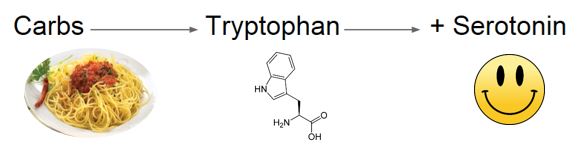
In one study, individuals who displayed symptoms of anxiety prior to consuming a carbohydrate-rich snack were much more relaxed afterwards (Wurtman, 1986). Sound familiar? Foods high in calories are good for the brain in that they reduce psychological stress and bring calm; however, such foods may become a conditioned coping mechanism for stress and may generate an addiction. In fact, carbohydrates and antidepressants have been observed to have the same effect on serotonin levels in the brain. Serotonin has also been shown to be involved in appetite regulation, which explains why when under stress, you might experience a drive to eat for highly palatable foods, which are low in nutrients but high in sugar and fat (Wurtman, 1986).

Another substance that comes into play is cortisol, a hormone similar to adrenaline which is released in the body as a reaction to stress, and motivates caloric dense food intake (Adam & Epel, 2007). If you are prone to higher cortisol reactivity than others (you can blame genetics for that), you are more likely to increase food intake in order to cope. More great news: stress can also lead to feeling out of control when eating (Groesz, et al., 2012).
So, what is there to do? There are many ways to raise serotonin levels in the brain that do not involve a box of Oreo cookies or antidepressants! Meditation, changing of thoughts (induced individually or through therapy – link to Brian’s post), exposure to bright light, and exercise are other ways to increase serotonin levels (Young, 2007). Mindfulness, being in the present moment, is also an encouraged strategy. For more strategies on how to cope with anxiety: (links to other blogs on anxiety).
Feeling sick to your stomach before a performance?
 Most performers experience music performance anxiety prior to an important concert or audition. Anxiety consists of a stress response in the body manifested through physical symptoms such as an increased heart rate, sweating and release of adrenaline. The “fight-or flight” is one type: the body reacts to a perceived life-threatening event, and energy is focused on the organs essential to survival. There is an increased blood supply to the brain, and increased stimulation of the skeletal muscles, which results in a decreased blood flow to the organs of the digestive system (Everly & Lating, 2013). Anxiety may therefore result in a loss of appetite, and other similar symptoms such as agitated stomach, “butterflies”, cramps, nausea, strange taste in the mouth, or even vomiting and diarrhea. Key to countering these effects are good nutritional habits, sufficient sleep and efficient stress management strategies (Schwertly, 2014).
Leave a Reply