
Are the long hours of practicing and rehearsing causing pain or discomfort? Have you ever needed to stop playing due to pain? Performance-related pain is an issue musicians may struggle with, and it can affect one’s playing both physically and psychologically. Understanding where and how injuries occur is one of the key factors in reducing their prevalence.
Musculoskeletal System
Many playing-related injuries occur in the musculoskeletal system, which includes tendons, ligaments, joints, and muscles. Tendons are tissues connecting muscle to bone, whereas ligaments are tissues connecting bone to bone. Ligaments can also attach bone and cartilage, forming a joint and providing limited range of movement at the joint. Joints are the points at which bones connect, and muscles are made up of soft tissue containing protein. Repetitive injuries can weaken the joints involved (Spencer & Shahsavari, 2012).
Most musculoskeletal disorders in musicians occur in the upper limb, upper trunk, and neck (Lederman, 2003). According to Spencer and Shahsavari (2012), the upper extremity is not designed for structural stability or bearing weight, but rather to enhance movement such as dexterity in the fingers and range of motion at the shoulder. Many musicians bear the weight of their instruments in awkward positions for long periods of time on a daily basis, which may lead to pain and injury in the upper extremity.
Musicians as Athletes
Musicians are often thought of as small-muscle athletes in the field of medicine due to the type of motor skills they use and the amount of training required. Thinking of musicians this way may give people a better understanding of the intensity of musical training, and the strain this can produce on musicians’ bodies. The unnatural movements required to play various instruments make musicians more prone to getting a musculoskeletal injury (Elbaum, 1986).
Types of Injuries
Musicians are at risk for particular types of musculoskeletal disorders including, but not limited to, tendonitis, tenosynovitis, bursitis, spinal pain, and focal dystonia (Elbaum, 1986). Tendonitis indicates inflammation of the tendon, whereas tenosynovitis indicates inflammation of the tendon sheath. Bursitis means inflammation of the bursa, a fluid-filled sac between the tendons and bones that acts as an anti-friction device (Canadian Centre for Occupational Health and Safety, 2015). Focal dystonia is involuntary movement caused by muscle contractions in a specific area of the body. For musicians, focal dystonia may occur in hand or facial muscles. Symptoms may include weakness and loss of control over muscles in the hand or embouchure (Brown, 1992).
What can you do to prevent injury?
To teach or not to teach: Collegiate injury prevention education
[toggle title=”References”]
- Elbaum, L. (January 01, 1986). Musculoskeletal problems of instrumental musicians*. The Journal of Orthopaedic and Sports Physical Therapy, 8, 6, 285-97. http://dx.doi.org/10.2519/jospt.1986.8.6.285
- Lederman, R. J. (May 01, 2003). Neuromuscular and musculoskeletal problems in instrumental musicians. Muscle & Nerve, 27, 5, 549-561. http://dx.doi.org/10.1002/mus.10380
- Louis Armstrong Foundation. (2015). Louis Armstrong Educational Foundation. Retrieved from http://www.louisarmstrongfoundation.org/index.php
- Spencer, H., & Shahsavari, S. (2012). Upper Limb. In P.J. Adds & S. Shahsavari (Eds.), The musculoskeletal system (pp. 3-28). New York: Informa Healthcare. http://dx.doi.org/10.3109/9781841848761.002
[toggle title=”Media”]
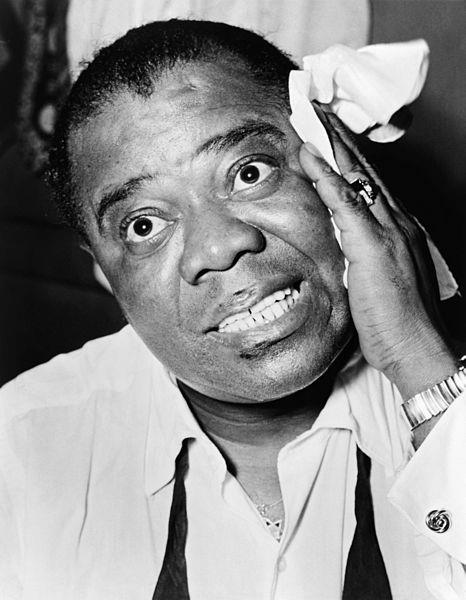
- Louis Armstrong Portrait (1953): By Herman Hiller (Library of Congress[1]) [Public domain], via Wikimedia Commons. From the New York World-Telegram and the Sun Newspaper Photograph Collection.
[/toggle]
I think this is a great article to help us as musicians become more aware of the injuries caused by the strain we put on our body from constantly practicing. We must take better care of ourselves from the start to play without tension throughout our careers!
I totally agree Alexis! The earlier we start taking care of ourselves during practice and away from the instrument, the more likely we will be able to play without tension throughout our careers.
I love to think about musicians as athletes. I think it heightens the awareness of how important it is to practice with physically efficient techniques so as not to strain the body.
I agree. Using our muscles efficiently is a key component of avoiding injury and pain.
Very well written. I like the reference of musicians being thought of as small-muscled athletes. It reminds me of how easy one can get injured by overusing or stressing muscles in a particular way. Thank you for bringing this to our attention. Enjoyed the posts.
I’m glad you enjoyed 🙂 Awareness is a key component of injury prevention.
I have been dealing with thumb, wrist, and forearm pain from my oboe playing for about 2 years now. It mainly started with intense graduate audition preparation but there were underlying hints of a problem before that, including thumb tingling and numbness and infrequent wrist pain. I have been combating it by seeing a deep tissue massage therapist who told me the problem was in my thumb and the other pain was a result of this. He gave me finger and forearm stretches and told me to avoid texting with my thumb as this further injures the hand. I also have a hand brace I wear sometimes and I try to consciously loosen my grip on the instrument when I play, which is very hard to catch when you’re concentrating on a difficult passage. I am starting to experiment with changing my hand position and adjusting the thumb rest to better suit myself.
Thanks for your comment! Interesting that you brought up texting…frequent use of technology (phone and computers) contributes to overuse of small muscles as well. I’m glad to hear you are being proactive about healing and working on changing your hand position to better suit yourself.
Yes. When I over practice I get pain in my left hand. I’m a clarinetist, and the left hand doesn’t even hold the weight of the instrument. However, it can get very tense from the side keys, which leads to injury.
I’ve experienced the same thing as a flutist. I think my tendonitis was caused by playing with tension, especially when I was learning very technical passages. It is good to be aware of the root of the problem in order to start fixing it!